Which Morocco Airport Should You Fly Into?
There is no single best airport for Morocco — the right one depends on where you actually want to go. Marrakech, Casablanca, Fes, Tangier and Agadir each open onto a different part of the country, and choosing the one that matches your itinerary can save a full day of backtracking you never needed to do.
Quick comparison
Before the detail, here is the short version. Each airport suits a different shape of trip:
- Marrakech (RAK) — the airport most Morocco Grand Adventure travelers fly into. Best if your trip centers on Marrakech, the Atlas Mountains, Aït Ben Haddou or the classic southern routes to the Sahara.
- Casablanca (CMN) — Morocco's largest city and commercial centre. Makes sense when it's simply where your flight lands, or when a wider loop through the imperial cities matters more than starting in Marrakech.
- Fes (FEZ) — a strong choice for travelers prioritizing Fes itself, the Middle Atlas, and the more direct northern road to the Sahara.
- Tangier (TNG) — the natural choice for northern Morocco: Chefchaouen, Tétouan and the Rif, and for travelers arriving by ferry from Spain or continuing south from Europe.
- Agadir (AGA) — useful when the Atlantic coast is part of the plan, or for a trip combining beach time with a southern desert route.
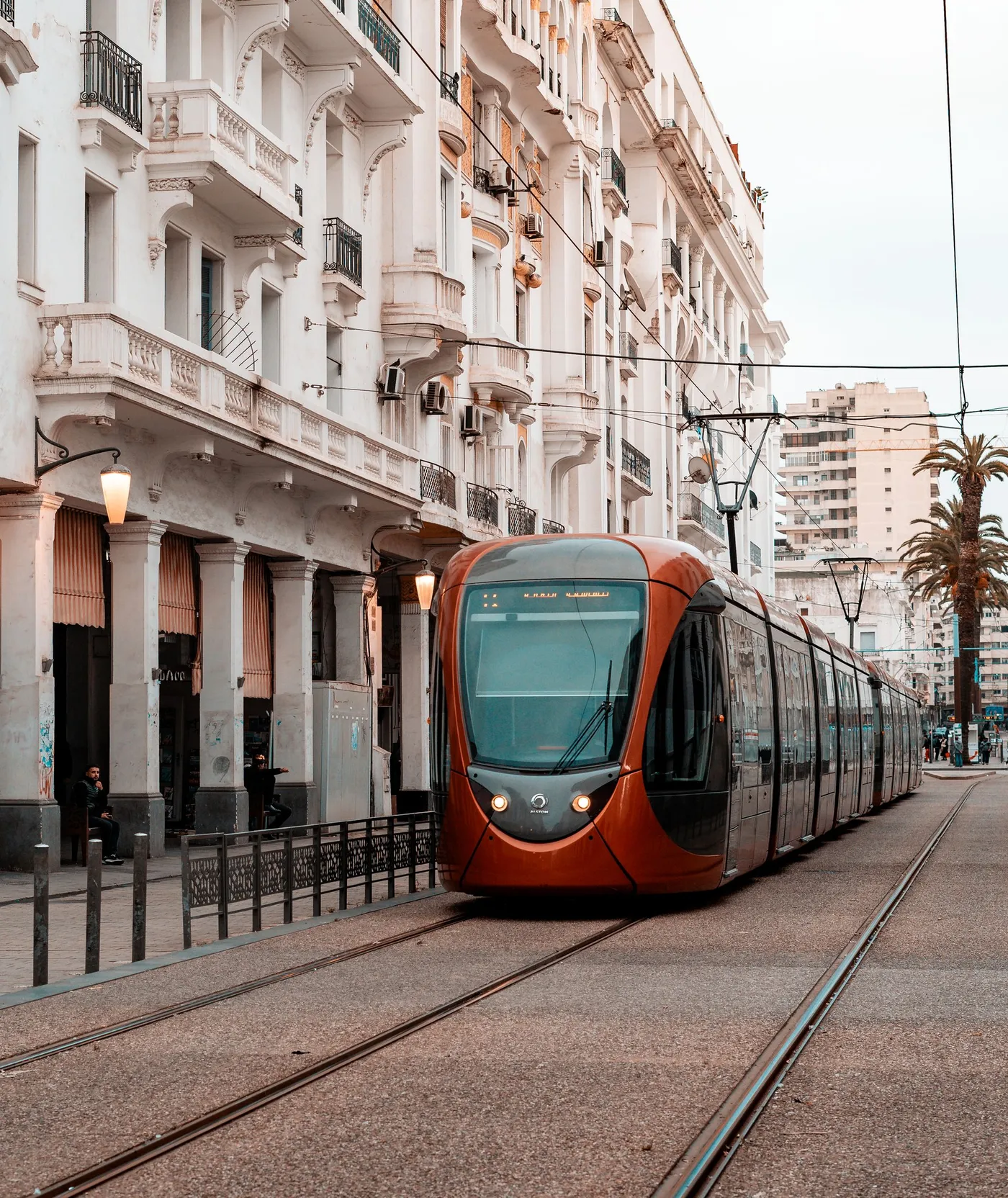
Marrakech Airport (RAK)
Marrakech Menara Airport (IATA: RAK) sits a short distance from the city itself, which is part of why it's the most straightforward option on this list: you land, and the Red City's medina, souks and riads are right there. It's also the natural starting point for the High Atlas — Imlil and the Ourika Valley are both day trips from Marrakech — and for the classic southern road toward Aït Ben Haddou, Ouarzazate and the Sahara.
If your trip is built around Marrakech, the Atlas, or a Sahara route that runs south over the Tizi n'Tichka Pass, this is almost always the right airport to search first.
An official, pre-paid taxi rank sits right outside the terminal, with fares fixed by destination and time of day posted on a board at the rank — agree the fare (or ask for a metered receipt) before the car moves. Posted rates and night surcharges do change from time to time, so treat any figure you read in advance as a guide rather than a locked-in quote.
Casablanca Airport (CMN)
Choose Casablanca deliberately when your trip is shaped as a loop through the imperial cities rather than centred on Marrakech and the south: landing at Mohammed V International (IATA: CMN) puts Rabat, Meknès and Fes all ahead of you in one direction, with nothing behind you to double back for. It's also the practical choice whenever Casablanca is simply where your flight lands — in which case the real question isn't whether to avoid it, but which direction to take out of it. Rabat–Salé Airport (RBA), a smaller airport nearby, serves the same imperial-cities loop and is occasionally the better-priced option into it.
From Casablanca, two shapes work well: continue toward Marrakech to pick up the classic southern Sahara routes, or head north and east through Rabat, Meknès and Fes for an imperial-cities itinerary that reaches the desert without ever touching Marrakech.
Casablanca is also the one airport on this list with a direct train connection: an ONCF station sits inside Terminal 1, with services running through the day to Casa-Voyageurs and onward across the national network toward Rabat, Fes and Marrakech — genuinely useful if you are travelling on without checked luggage to collect from a rental desk. Timetables and fares are set by ONCF and do change, so check oncf.ma for the current schedule rather than relying on a number written here.
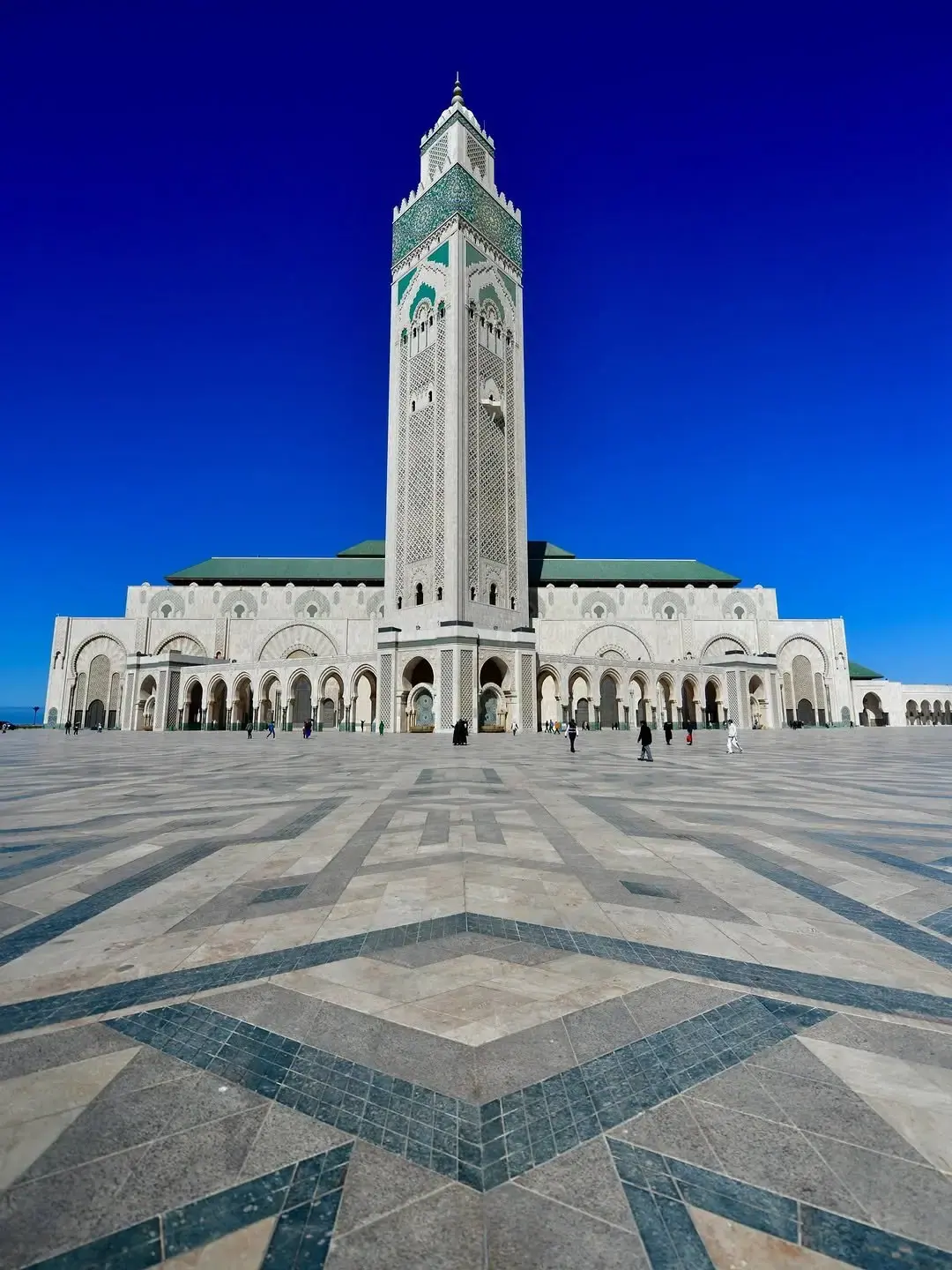
Fes Airport (FEZ)
Fes–Saïss Airport (IATA: FEZ) puts you directly in Morocco's cultural heart, with the Middle Atlas and the Ziz Valley forming a more direct road to the Sahara than the Marrakech crossing. If Fes el-Bali's medina, the Chouara Tannery and Al Qaraouiyine University are on your list regardless, flying here instead of into Marrakech removes a backtrack.
It also suits travelers building a one-way itinerary — Fes to Merzouga to Marrakech, for example — more naturally than starting and ending in the same city would.
Tangier Airport (TNG)
Tangier Ibn Battouta Airport (IATA: TNG) is the airport for northern Morocco specifically — Chefchaouen's blue medina, Tétouan, and the Rif Mountains sit close by, and the city itself is a short ferry crossing from Spain for travelers arriving overland from Europe. It makes little sense as an entry point if the Sahara is your only goal; it makes a great deal of sense if northern Morocco is part of the trip at all.
Agadir Airport (AGA)
Agadir Al Massira Airport (IATA: AGA) suits travelers who want the Atlantic coast in the itinerary — the city's beaches and promenade, with Taghazout's surf village and Essaouira both reachable along the same coast — and who are willing to fly or drive toward Marrakech to pick up a Sahara route from there. It's a genuinely different kind of starting point: beach-first rather than medina-first.
Which airport is best for a Sahara trip?
If the Sahara is the main reason for the trip, the airport decision isn't really about picking the 'better' route — both Marrakech and Fes are genuine, well-used gateways to Merzouga. It comes down to which city the rest of your trip is already built around. If Marrakech, the Atlas, or a round-trip back to where you started fits your plans, fly into Marrakech. If Fes itself matters to you, or you're building a one-way itinerary that finishes somewhere other than where it began, fly into Fes instead.
Casablanca and Agadir both work for a Sahara trip too, just with an extra step: from Casablanca, most routes continue through Marrakech or Fes; from Agadir, the usual pattern is to head toward Marrakech first. If you want the detailed route-by-route comparison between the Marrakech and Fes roads to Merzouga, our Marrakech vs Fes guide covers that; for the actual road distances and driving times once you've chosen a direction, our How to Get to Merzouga guide has the detail — both linked below.
Closer to the Sahara: Ouarzazate and Errachidia
Two small regional airports, Ouarzazate (IATA: OZZ) and Errachidia – Moulay Ali Cherif (IATA: ERH), sit geographically closer to Merzouga and the Erg Chebbi dunes than any of the airports above — worth knowing about, even though neither is a realistic first choice for most international travelers. Ouarzazate sees occasional, mostly seasonal flights, largely from Europe, but availability varies month to month rather than following a fixed daily schedule; most travelers still reach the Ouarzazate area by road from Marrakech instead, a drive of roughly 3–4 hours. Errachidia sits in the Tafilalet oases, closer still to the dunes, but scheduled flights there are limited and inconsistent.
In practice, this is why our own routes fly travelers into Marrakech or Fes and cover the final stretch to Merzouga by private road transfer as part of a multi-day itinerary, rather than routing through either regional airport — it is the more reliable option, not just our default one. Our How to Get to Merzouga guide covers the road distances and driving times in detail.
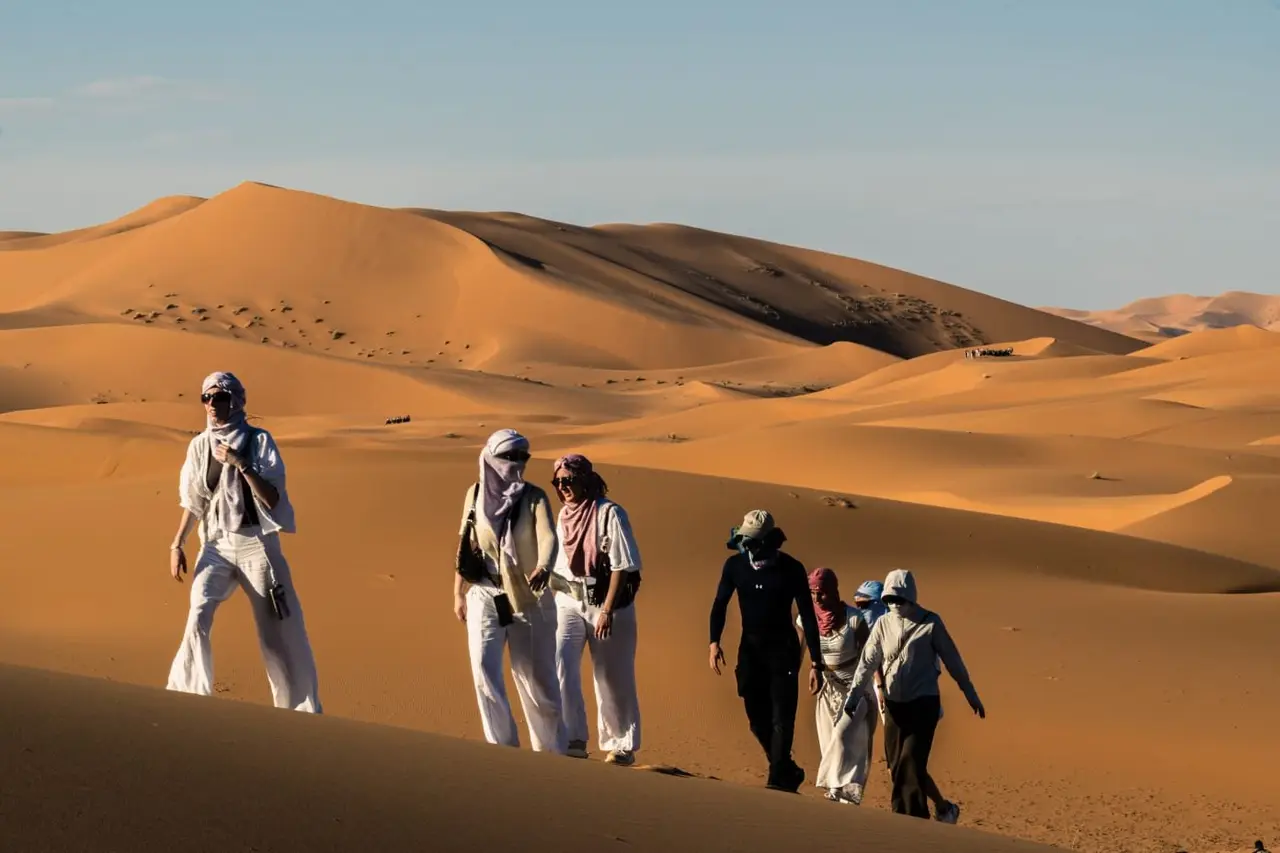
Which airport should you choose for your itinerary?
A few real shapes this takes, matched to routes we actually run:
- Marrakech + Sahara — fly into Marrakech, take the classic 3-day or 4-day route to Merzouga and back.
- Fes + Sahara — fly into Fes, take the more direct northern route to Merzouga.
- Marrakech + Fes + Sahara — fly into one, out of the other, on a route like the 5-day Imperial Cities & Desert journey that links Marrakech, the Sahara, Fes, Meknès and Chefchaouen without retracing any road.
- Casablanca + Imperial Cities + Sahara — fly into Casablanca and continue on a route built for exactly that start point, reaching Fes and the desert without backtracking to Marrakech.
- Northern Morocco — fly into Tangier for a Chefchaouen- and Rif-focused trip, with the option to continue toward Fes.
- Agadir + Sahara — fly into Agadir for the Atlantic coast, then pick up a private route toward Marrakech and the dunes.
Related Tours
3-Day Luxury Sahara Tour from Marrakech
A three-day private journey from Marrakech to the dunes of Merzouga, built for travelers who want a real Sahara experience without pretending the road is short. Cross the High Atlas, visit Aït Ben Haddou, travel through the Dades Valley and Todra Gorge, reach Merzouga and Erg Chebbi for a sunset camel trek and desert-camp night, then return to Marrakech through the changing landscapes of southern Morocco. Three days is the shortest practical format for this overland route; if you prefer slower travel or more time in the desert, ask us about a longer itinerary.
3-Day Fes to Merzouga Sahara Desert Tour
A focused private journey from Fes to the Sahara at Merzouga. Travel south through the Middle Atlas and Ziz Valley, reach Erg Chebbi for the desert experience, then continue or return according to the confirmed plan. The route is intentionally compact; travellers wanting more time around the dunes should extend it.
5-Day Imperial Cities & Desert
From the ochre imperial capital of Marrakech to the blue-washed lanes of Chefchaouen, this five-day journey weaves together Morocco's greatest imperial cities and a night under the Sahara stars. Cross the High Atlas to the UNESCO ksar of Aït Ben Haddou, sleep in a luxury desert camp among the dunes of Erg Chebbi, explore the medieval labyrinth of Fes, and wander the Roman ruins of Volubilis.
4-Day Marrakech to Merzouga Sahara Desert Tour
A more comfortable alternative to the classic three-day Marrakech–Merzouga loop. The four-day format keeps the main southern highlights but gives the journey more breathing room, with a dedicated day around Merzouga before the return to Marrakech.
7-Day Imperial Cities & Sahara Escape
Experience the very best of Morocco in seven unforgettable days. Cross the spectacular High Atlas Mountains over the Tizi n'Tichka Pass, explore the UNESCO kasbah of Aït Ben Haddou, wind through the Dades Valley and the towering Todra Gorge, then ride camels across the golden dunes of Erg Chebbi to a luxury desert camp beneath the stars. Journey north through the Ziz Valley and cedar forests to the medieval imperial city of Fes, before returning to Marrakech through some of the country's most breathtaking landscapes.
5-Day Casablanca to Merzouga & Fes Desert Route
A private route from Casablanca east to Fes and then south into the Sahara, with a night in the dunes at Erg Chebbi before returning to Fes. It pairs the imperial cities and the Roman site of Volubilis with the cedar forests of the Middle Atlas, the palm-filled Ziz Valley and a sunset camel trek in Merzouga. A personalised price is quoted for this route rather than published in advance; the exact total depends on your party size and the accommodation you choose, and is confirmed around your dates before booking.
3-Day North Morocco: Tangier, Chefchaouen & Tétouan
A private three-day loop through Morocco's north, starting and finishing in Tangier. The route runs to the whitewashed Andalusian medina of Tétouan, then to Chefchaouen for two nights, with a day into the Akchour valley for its waterfalls and the natural stone arch known as God's Bridge. This is a different Morocco from the desert routes: green Rif mountains, Spanish-inflected architecture, and a slower, cooler pace.
3-Day Private Sahara Route from Agadir
A private three-day Sahara planning route starting in Agadir. The Moroccan National Tourist Office confirms Agadir as a gateway toward the Sahara and documents the southern Morocco connection toward the desert. Per-traveler pricing depends on your party size; the exact total is confirmed around your dates before booking.
Destinations in this Guide
Marrakech
The Red City — vibrant medinas, Jemaa el-Fnaa square, luxury riads.
Casablanca
Morocco's largest city and economic capital — the Hassan II Mosque and French-era art deco streets.
Fes
The cultural heart — world's oldest university and medieval medina.
Tangier
Gateway between Africa and Europe — Strait of Gibraltar, art, and intrigue.
Agadir
Morocco's modern beach resort — golden sands and year-round sunshine.
Merzouga
Gateway to Erg Chebbi — the most dramatic dunes in Morocco.
Keep planning
- How to Get to Merzouga — From Marrakech, Fes and Beyond
- Getting Around Morocco — Transport, Realistically
- Morocco Basics — Location, Language, Currency and Government
- Marrakech vs Fes — Which City for Your Sahara Trip?
Frequently asked questions
-
Which airport is best for a first trip to Morocco?
Most first-time travelers fly into Marrakech or Fes, since both put you close to the sights most itineraries are built around. Casablanca is also a common and perfectly practical entry point, especially on a wider, country-spanning trip.
-
Which Morocco airport is best for the Sahara?
Marrakech and Fes are the two practical choices. Marrakech makes sense when the wider itinerary is centred on Marrakech or the south; Fes makes sense when Fes is part of the itinerary, or the trip follows a different one-way route. Our Marrakech vs Fes guide covers the detailed route comparison, and our How to Get to Merzouga guide covers the practical overland details.
-
Is Marrakech or Fes better for starting a Sahara trip?
It depends on your itinerary rather than which is 'better': choose Marrakech if the rest of your trip is built around Marrakech, the Atlas, or a round-trip back to your starting point; choose Fes if Fes itself is part of your plans, or you're routing one-way to a different finish city. Our Marrakech vs Fes guide compares the two roads in detail.
-
Should I fly into Casablanca or Marrakech?
If your trip is centered on Marrakech and the south, fly into Marrakech directly. If Casablanca is simply where the best flight lands, or your itinerary is built as a wider loop through the imperial cities, Casablanca works fine as a starting point.
-
Which airport should I use for northern Morocco?
Tangier. It sits closest to Chefchaouen, Tétouan and the Rif, and is also the easiest airport for travelers connecting from a ferry crossing from Spain.
-
Can I fly into one airport and out of another?
Yes — several of our private routes are one-way by design, such as Fes to Marrakech via the Sahara, specifically so you don't have to fly in and out of the same city.
-
What is the closest airport to Merzouga and the Sahara?
Errachidia and Ouarzazate sit closest on a map, but both have limited, inconsistent flight schedules rather than reliable daily service. Most travelers fly into Marrakech or Fes instead and cover the final stretch to Merzouga by road — a well-established route we run ourselves, and a more reliable option than waiting on a seasonal regional flight.
Sources & further information
- Visit Morocco — official website of the Moroccan National Tourist Office — ONMT (Moroccan National Tourist Office)
Ready for the real Sahara?
Talk to a local Merzouga guide and shape the desert night that suits your group, pace and budget. Build my Morocco journey · WhatsApp a local expert.