10-Day Morocco Student Tour
A ten-day student route linking Marrakech, Aït Ben Haddou, the Erg Chebbi Sahara, Fes and Chefchaouen. For university groups of 15+.
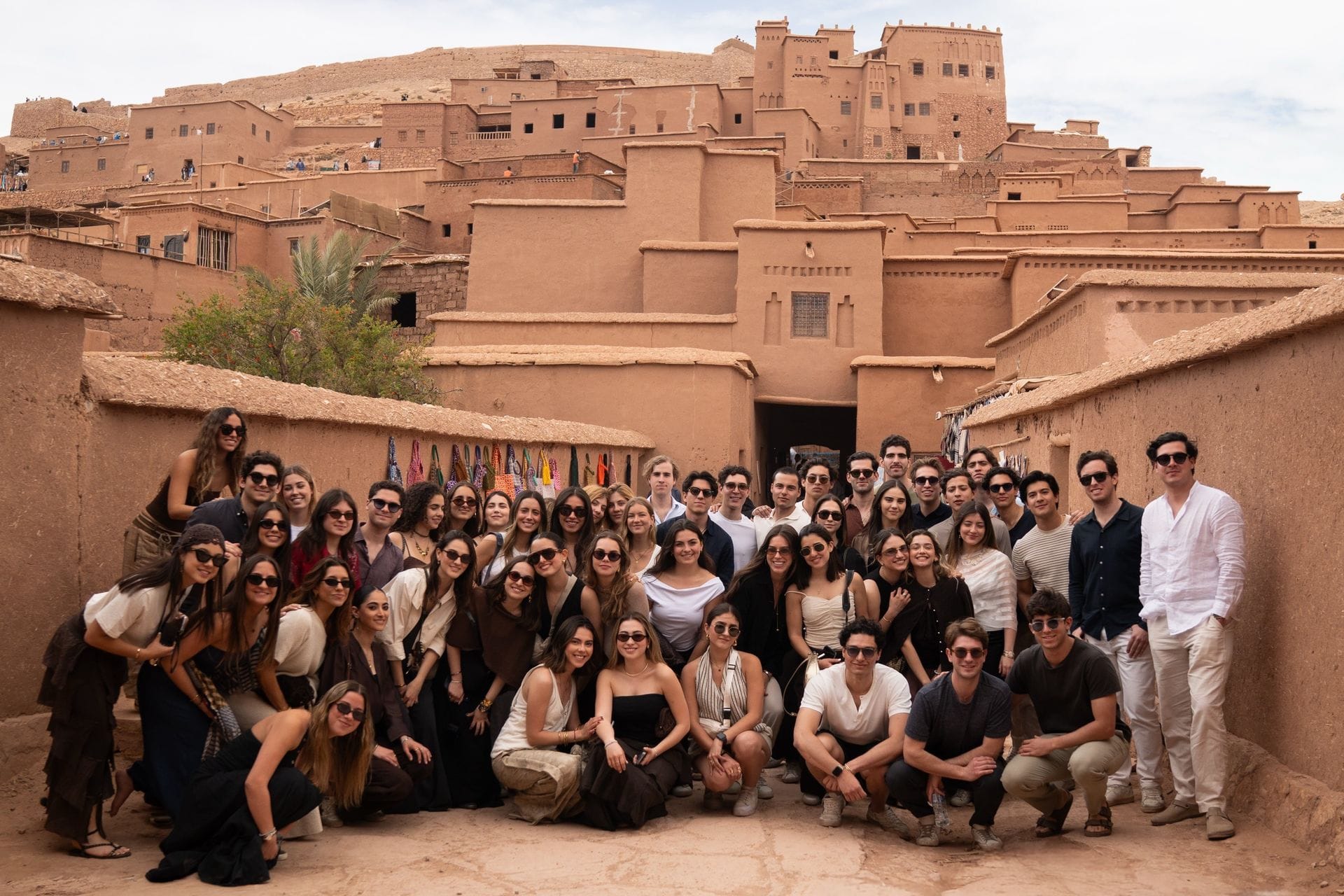
Ten days is long enough to stop generalizing about Morocco. The group sees a Roman-era site and a medieval university city and a blue mountain town and an erg, and by the end nobody is describing them with the same words.
Tour overview
- Duration: 10 Days
- Starts: Marrakech or Casablanca
- Ends: Marrakech or Fes, depending on the group's flights
- Main regions: Atlantic coast · Imperial cities · Rif · Middle & High Atlas · Sahara
- Travel style: Full-country overland journey with multiple multi-night stops
- Organized for student and university groups of 15 or more participants.
Why this works for students
Short trips teach a version of Morocco. Ten days teaches the differences inside it — that Fes and Marrakech are not interchangeable, that the north is green and the south is not, and that Amazigh, Arab, Andalusian and French histories sit in different proportions in different cities.
The length allows multi-night stops. Students unpack, get their bearings, and can go back to a place a second time with a question they did not have on the first visit.
It fits a full study-abroad module or a faculty-led program where the travel is the course rather than an add-on to it.
Itinerary
The south begins in Marrakech
Day 1 — Landing, and doing very little
The group arrives and settles. Depending on the flights, this is Marrakech or Casablanca. The first evening is deliberately light — a walk, a meal together, and a practical briefing about the route, the pace and what to expect.
Students who have never traveled outside their own country get the most out of a soft first night. Nobody absorbs a medina well on three hours of sleep.
- Arrival
- Orientation walk and group dinner
Day 2 — Marrakech at street level
A full day in Marrakech. The medina is the main event — a dense, walled, working city where the street pattern itself is the lesson. The group moves through souks organized by trade, past workshops where things are still made rather than only sold.
There is time at the historic monuments and gardens the city is known for, which give the group somewhere quiet to actually talk about what they just walked through.
In the evening, Jemaa el-Fna. It is loud, crowded and genuinely unlike anything most students have experienced, and it is worth going in with a plan for where to meet.
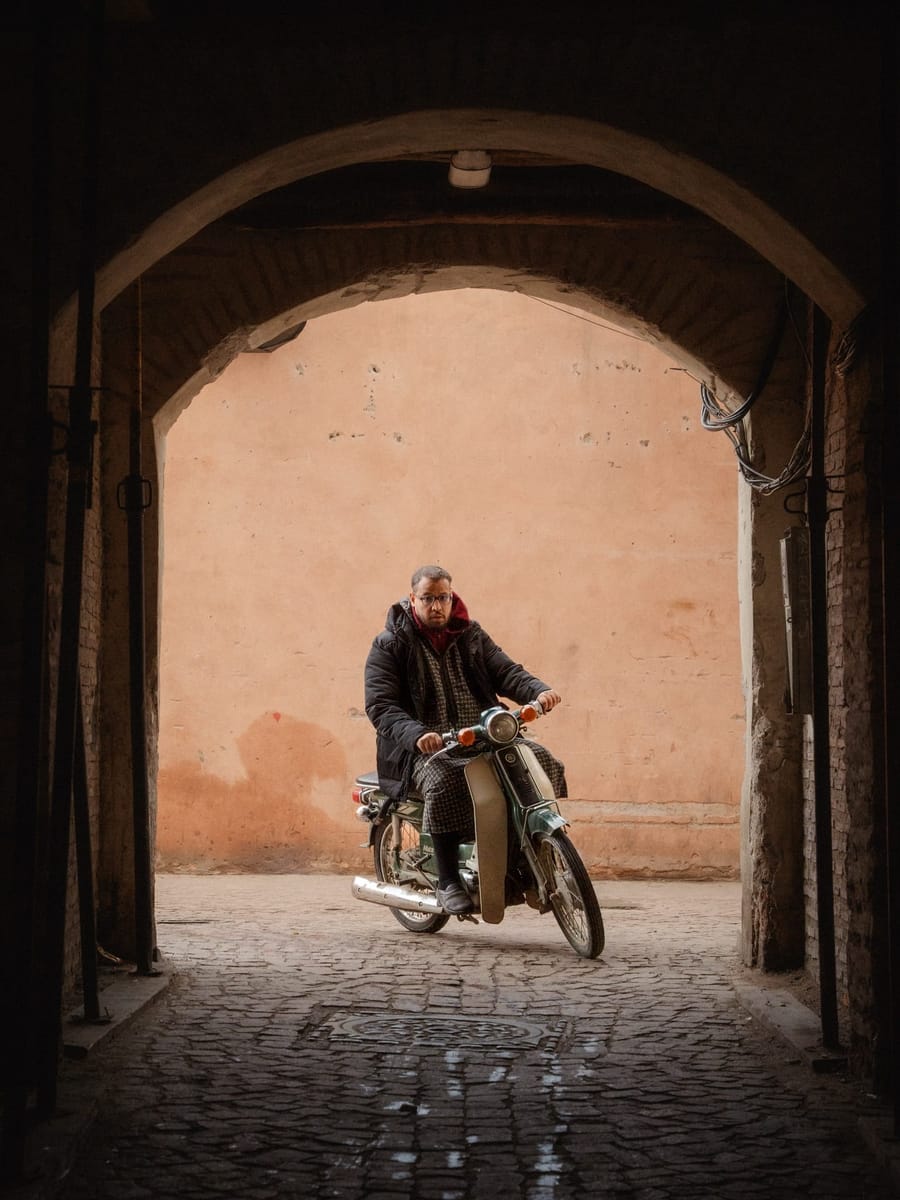
- Medina and souks
- Historic monuments and gardens
- Jemaa el-Fna in the evening
Over the mountains, into the desert
Day 3 — The pass, and the red country beyond it
Two days of Marrakech makes the far side of the mountains land harder. The city is loud and enclosed; four hours later the group is looking at a hundred kilometers of nothing, in a red that does not appear anywhere in the north of the country.
Aït Ben Haddou is the first thing on this trip built entirely out of the ground it stands on. After the tiled, carved, imported-material architecture of Marrakech, a village made of the hillside behind it is a useful contrast — and it is the one students tend to bring up again a week later in Fes.
The group sleeps in the valley country beyond the ksar. From here the route stops being about cities for a while.
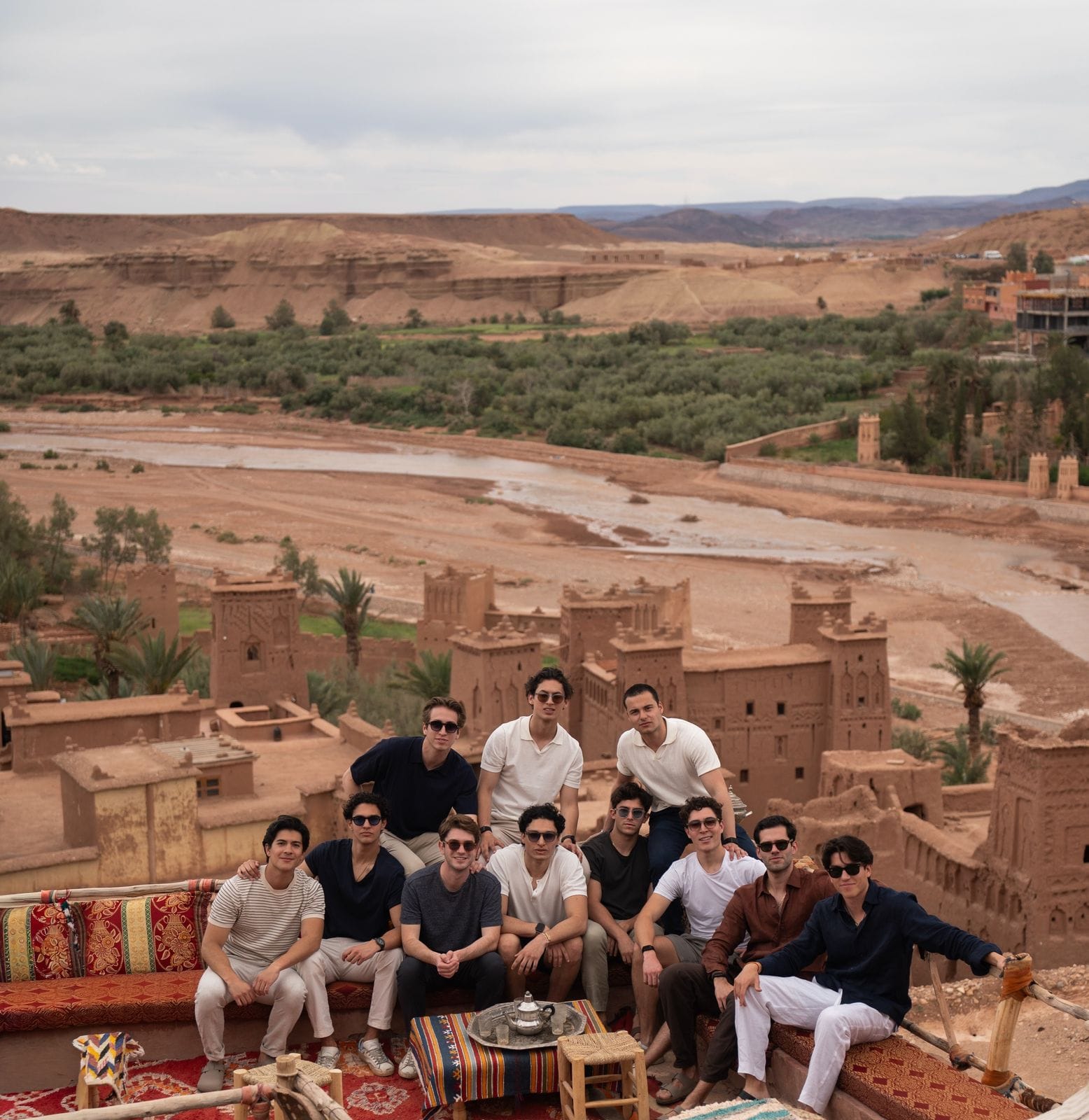
- Tizi n'Tichka
- Aït Ben Haddou
- Overnight in the valleys
Day 4 — Following the water south
Through the Dades and Todra country, where palm groves trace the water and bare rock does everything else. There is time to walk into a gorge and see how the villages use what comes through.
By late afternoon the mountains are behind the group and Erg Chebbi is ahead. The night is at a desert camp.
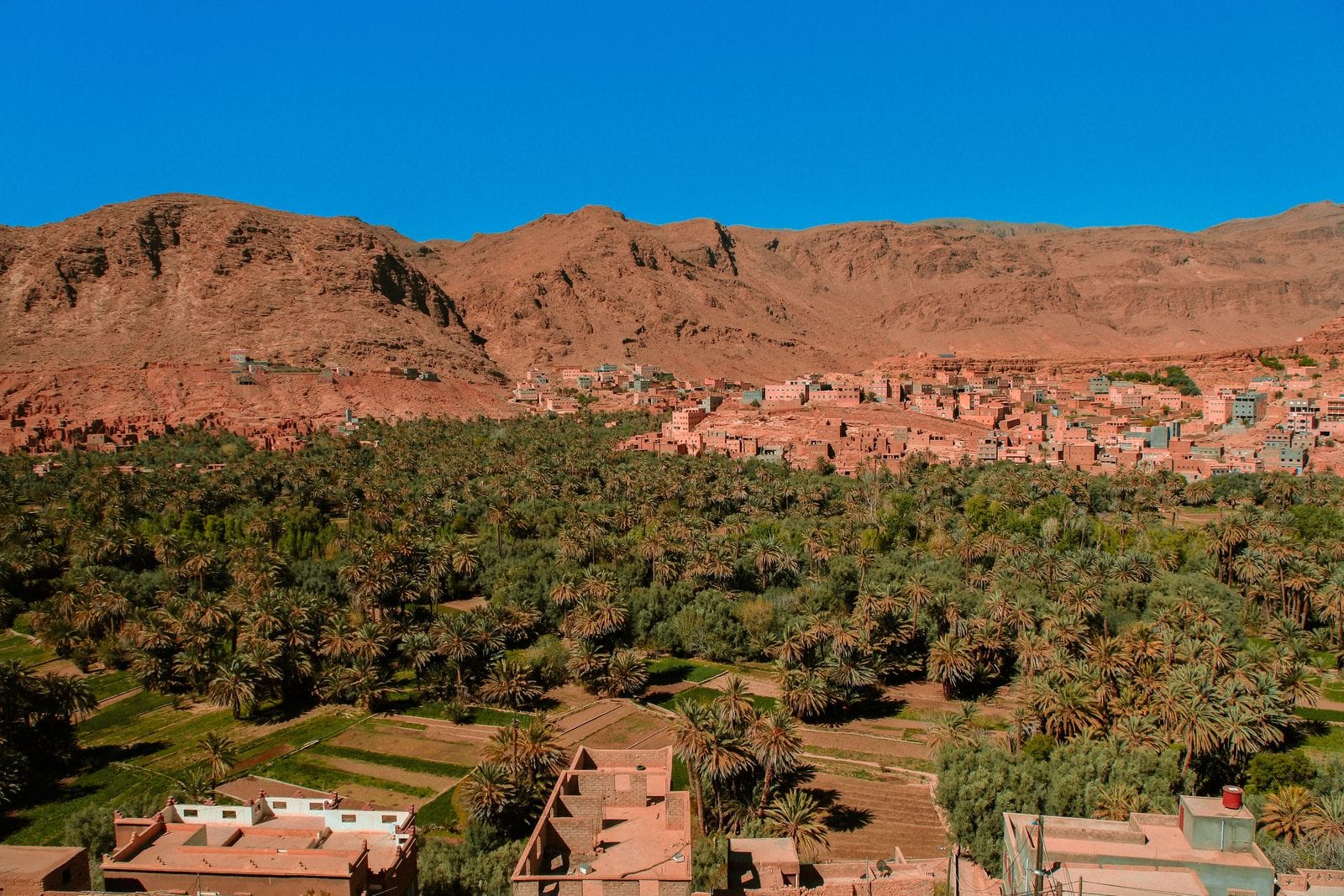
- Dades and Todra
- Arrival Erg Chebbi
- Night at desert camp
Day 5 — A day that belongs to the desert
Sunrise, then a day in the desert rather than a drive out of it. This is where the group meets people who live in the desert, sees how a nomad camp works, and spends the cooler hours out on the dunes.
Groups that want an active afternoon can take 4x4 or buggy time on the sand. Groups that want a slower one can have that instead.
Second night at the camp, with no early departure the next morning to cut the evening short.
- Sunrise over the dunes
- Desert communities
- Optional sand activities
- Second night at camp
The long turn north
Day 6 — North into cedar country
A long travel day, and a genuinely interesting one. The route runs north and the country changes more than students expect — the pre-Sahara gives way to high plateau, then to cedar forest and cooler air.
It is the clearest single demonstration on the trip that Morocco is not one climate. The group overnights on the route north.
- Middle Atlas
- Cedar forest country
- Overnight en route
Day 7 — Inside Fes el-Bali
Fes el-Bali is the reason this trip is ten days and not six. It is one of the largest car-free urban areas anywhere, and it does not reveal itself quickly. The group goes in with a local guide because that is the only sensible way to do it.
The day covers the old city's craft economy — the tanneries, metalwork, weaving — and its scholarly history, including the university quarter. Students who found Marrakech overwhelming usually find Fes older, denser and quieter in a way they can work with.
- Fes el-Bali medina
- Tanneries and craft workshops
- Historic university quarter
Roman ground and the Rif
Day 8 — Mosaics on a hillside
North of Fes the group reaches a very different layer of history: Roman-era ruins on open farmland, with mosaics still in place and a street grid readable from ground level. Seeing a classical site in North Africa reframes a lot of what students assume about the Roman world.
Nearby, a hillside town with a completely different character — whitewashed, stacked and religiously significant — before the road continues north into the Rif.
- Roman archaeological site
- Hillside town
- Into the Rif mountains
Day 9 — A town you can see all of
Chefchaouen is small, steep and blue, and it is the only place on this itinerary where the group can see the whole town from above in ten minutes of walking. After a week of large cities and open desert, the scale is a relief.
There is time in the medina, time to walk up for the view, and time that is genuinely unstructured — which after eight days of moving is worth scheduling deliberately.
- Chefchaouen medina
- Walk to the viewpoint
- Free time
Day 10 — The last morning
A final morning, then transfer to the departure airport. Where the flights allow, we build in a last stop on the way rather than going straight to the terminal.
Most groups spend this drive arguing about which part was best, which is a reasonable measure of whether ten days was the right length.
- Transfer to departure airport
What students will experience
- Two great medinas — Marrakech and Fes back to back, far enough apart in the itinerary to compare properly.
- Roman North Africa — A classical site with mosaics in situ, on farmland rather than behind glass.
- The Rif and Chefchaouen — Green mountains and a small blue town — the part of Morocco most short trips never reach.
- High Atlas crossing — A real mountain pass with the landscape changing on both sides of it.
- Two nights at Erg Chebbi — A full desert day, not a sunrise-and-leave.
- Desert communities — Time with people who live in the Sahara, including how a nomad camp is set up and moved.
- Craft economies — Tanneries, metalwork and weaving seen as working trades rather than demonstrations.
Learning through experience
- History — Roman, medieval Islamic, Andalusian and colonial layers encountered in the places they happened rather than in sequence on a slide.
- Urban geography — Two medinas of different ages and densities, plus a small mountain town, make street pattern and city growth directly comparable.
- Physical geography — Atlantic plain, High Atlas, pre-Sahara, erg, Middle Atlas cedar forest and the Rif — most of Morocco's climate zones in one route.
- Anthropology and language — Arabic, Amazigh, French and Spanish influence are unevenly distributed across the country, and the route makes that pattern obvious.
- Economy and craft — Traditional production in Fes and Marrakech, oasis agriculture in the south, and herding in the desert.
- Environment — Water scarcity, irrigation, desertification and forest are all encountered on the ground within the same ten days.
What is included
- Private transport for the group for the full route, with a driver
- Nine nights of accommodation, including two nights at a desert camp
- Breakfasts, and dinners on the nights the group is with us
- A local guide accompanying the group for the journey
- Local city guides in the major medinas
- Camel experience at Erg Chebbi
- Airport transfers on arrival and departure
Not included
- International and domestic flights
- Travel insurance
- Lunches and drinks unless agreed in the final program
- Entrance fees to sites not listed in the confirmed itinerary
- Optional activities and personal spending
Practical information
Accommodation
Nine nights, mixing city accommodation in the larger stops with valley accommodation and two nights at a desert camp. Multi-night stays are used wherever the route allows it.
Transport
Private vehicles for the whole route. Morocco is large and two of the ten days are substantial drives; the itinerary is built so those days have something to look at rather than being pure transit.
Meals and dietary needs
Vegetarian, vegan, gluten-free and halal can be arranged with advance notice across the whole route. Send the list with numbers when the group is confirmed.
Free time
Built in deliberately, particularly in Chefchaouen and the desert. Ten days of continuous scheduling does not work for a student group, and we do not plan it that way.
What to bring
Layers for a genuinely wide temperature range — cold desert nights, cool Middle Atlas mornings and hot afternoons in the south. Closed walking shoes, sun protection, a head covering, a power bank, and a day bag.
Weather
Spring and autumn suit this route best because it crosses several climate zones. Summer is hot in the south; winter is cold at altitude and in the desert at night. Both are workable with adjusted timing.
Group support and logistics
- A Morocco Grand Adventure guide travels with the group for the full ten days, with local city guides in the major medinas.
- The desert portion is operated by our own team in Merzouga.
- Group leaders have a direct contact throughout the program.
- On a route this long we expect to adjust as we go. Pace, free time and stop length can change during the trip if the group needs them to.
Questions from group leaders
Can this run as a faculty-led course rather than a tour?
That is what the length is for. Tell us the course, the learning outcomes and any site visits you need, and we will build the route around them instead of adding them to a fixed itinerary.
Can the tour start and end in different cities?
Yes, and on a ten-day route that often makes sense — for example arriving in one city and departing from another so the group is not retracing. Send us your flight constraints.
Can we adjust which cities are included?
Yes. The north-to-south spine is what makes the route work, but individual stops can be swapped, extended or dropped depending on your priorities and dates.
How much of the trip is driving?
It is a large country and there are two substantial travel days. We tell you where they fall when we send the route so there are no surprises.
What group sizes do you work with?
Groups of 15 or more. For a ten-day program with multi-night city stops, more lead time means better accommodation options.
Can dietary requirements be handled for the whole route?
Yes, with advance notice. The range of locations is why we ask for the list early rather than on arrival.
How does a study-abroad coordinator start the conversation?
Message us with the institution's country, group size, target dates, academic focus and any fixed constraints. We will come back with a route, the logistics and the parts we would push back on.