Sahara Desert Travel Guide — Morocco Desert Trips Explained
The Moroccan Sahara is not one uniform sea of sand — it is a sprawl of gravel plains, oases and a few distinct dune fields, the most accessible of which is Erg Chebbi at Merzouga. This guide ties the whole desert picture together: what it is, how to experience it and how Marrakech and Fes reach it.
Where the Sahara actually is in Morocco
The Sahara is the vast desert belt that runs across North Africa; only its far north-western fringe dips into Morocco. Travellers experience that fringe mainly as two dune fields (ergs): Erg Chebbi near Merzouga and the more remote Erg Chigaga beyond Zagora. Between them the terrain is largely gravel stony desert (known locally as reg) with scattered oases, plus the dramatic gorges and valleys of the southern High Atlas.
What draws most visitors to Merzouga is Erg Chebbi — Morocco's tallest dunes, up to roughly 150 metres, and the easiest to reach because the road runs almost to their edge. If you want the true silence of the deep desert and do not mind more driving, Erg Chigaga is the quieter alternative.
The core desert experiences
The rhythms of a Sahara visit repeat everywhere in the Moroccan desert. Late in the afternoon you leave the village and cross to the dunes; at sunset you ride a camel along the crest line; after dark you eat in a desert camp and lie under a sky dense with stars; at dawn you climb a dune for sunrise before riding back. Around that core, travellers add faster, higher-energy activities: quad biking on the firm ground around the dune field, or a 4x4 drive that reaches the highest crests and the wider desert beyond.
None of these activities replaces the others — each suits a different mood and a different part of the day, and a well-planned Merzouga day often combines two of them.
- Camel trekking — slow, and the classic way to reach a camp at sunset
- Desert camp night — dinner, music and stargazing between the dunes
- Quad biking — a high-energy afternoon on the flats around the erg
- 4x4 drive — reaching the tall crests and the wider desert country
- Sunrise and sunset — free, and the two best hours on the dunes
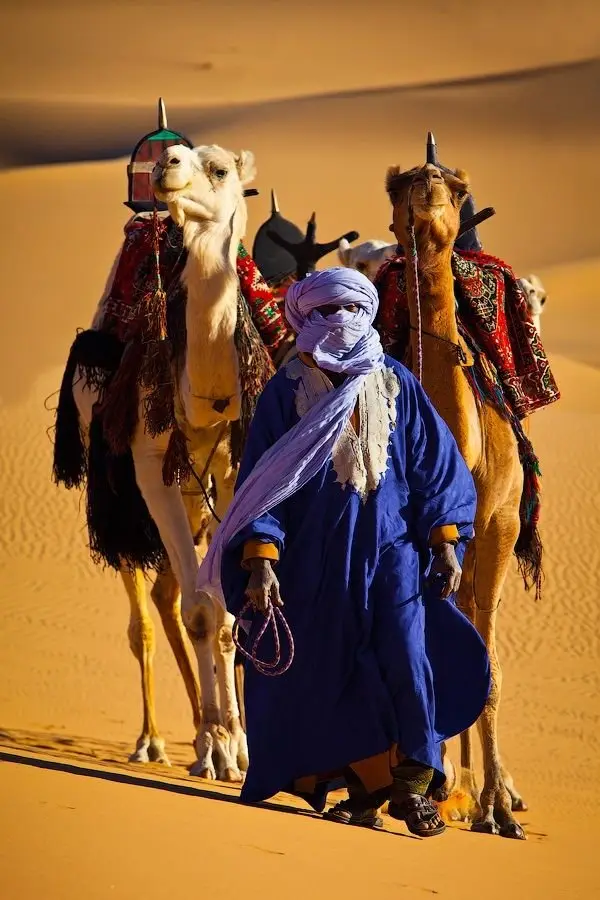
The classic route from Marrakech
Most first-time desert trips start in Marrakech. The drive climbs over the High Atlas at Tizi n’Tichka, passes the UNESCO-listed ksar of Aït Ben Haddou and the film-town of Ouarzazate, then winds through the Dades Valley and the Todra Gorge before turning southeast to Merzouga. It is roughly a 9–10 hour drive and is best spread over two travel days, with an overnight in the Dades or Todra area.
Done over three to four days it becomes a loop that is also the most popular Sahara trip in Morocco — the Atlas, Aït Ben Haddou, the gorges and the dunes in one route. See the dedicated Marrakech-to-Merzouga route guide for the stops in detail.
The classic route from Fes
A Fes-to-Merzouga trip is more direct. The road runs southeast through the Middle Atlas and the cedar town of Ifrane, over to Midelt, then down the long palm-lined Ziz Valley to Merzouga — roughly a 7–8 hour drive. Because it is shorter, a Fes departure can reach the dunes on the first day, which makes a 3-day Fes loop or a 4-day Fes-to-Marrakech one-way route very comfortable formats.
The scenery changes from green highlands to oasis to desert more gradually than on the Marrakech road. The Fes-to-Merzouga route guide covers the stops.
Sunrise, sunset and the night sky
The two best hours on the dunes are the golden hours around sunrise and sunset, when the sand turns from pale to amber to deep orange and the long shadows give the crests strong shape. After dark, away from village lights, the stargazing is among the clearest in Morocco — the Milky Way is frequently visible to the naked eye in the cooler months.
On our own Merzouga journeys the sequence is built from these hours: a sunset trek or 4x4 to catch the best light, a camp dinner under the stars, and a sunrise climb to begin the ride back. How the times shift through the seasons is covered in the dedicated sunrise and sunset guide.
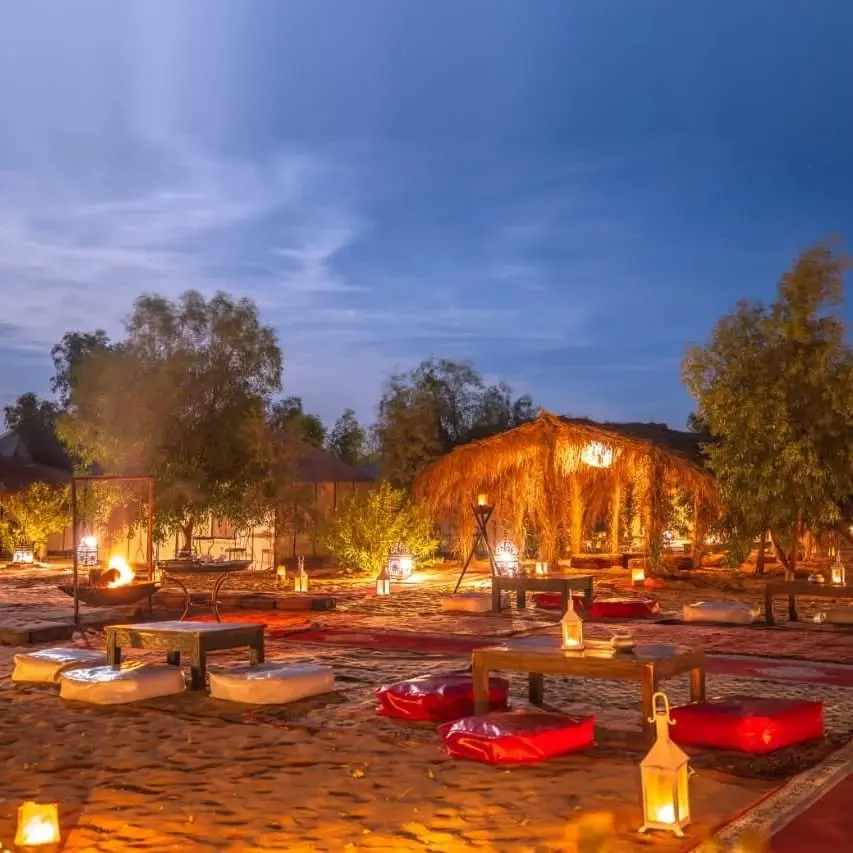
Culture on the desert fringe
The Sahara trip is not only dunes. South of Merzouga lies Khamlia, the Gnawa village whose music tradition draws visitors for late-afternoon performances. The weekly souk at Rissani, the historic trading town to the north, is a practical window into local life, and across the desert fringe you meet the nomad and semi-nomad communities who still live around the ergs. These cultural stops are optional but they genuinely round out the experience.
We never promise a staged or romanticised version of nomadic life — what we can offer is a respectful look at how people actually live around the dunes, arranged through local families and guides.
Best time and how long to plan
October to April is the comfortable window for trekking and camps; summer daytime heat on the dunes regularly exceeds 40 °C and makes midday activity unpleasant. One night between the dunes delivers the essential sunset-camp-sunrise sequence; a full extra day adds room for quad, 4x4 and cultural stops. The best-time and how-many-days guides go deeper into both of these.
Related Tours
3-Day Luxury Sahara Tour from Marrakech
A three-day private journey from Marrakech to the dunes of Merzouga, built for travelers who want a real Sahara experience without pretending the road is short. Cross the High Atlas, visit Aït Ben Haddou, travel through the Dades Valley and Todra Gorge, reach Merzouga and Erg Chebbi for a sunset camel trek and desert-camp night, then return to Marrakech through the changing landscapes of southern Morocco. Three days is the shortest practical format for this overland route; if you prefer slower travel or more time in the desert, ask us about a longer itinerary.
4-Day Marrakech to Merzouga Sahara Desert Tour
A more comfortable alternative to the classic three-day Marrakech–Merzouga loop. The four-day format keeps the main southern highlights but gives the journey more breathing room, with a dedicated day around Merzouga before the return to Marrakech.
3-Day Fes to Merzouga Sahara Desert Tour
A focused private journey from Fes to the Sahara at Merzouga. Travel south through the Middle Atlas and Ziz Valley, reach Erg Chebbi for the desert experience, then continue or return according to the confirmed plan. The route is intentionally compact; travellers wanting more time around the dunes should extend it.
4-Day Fes to Marrakech via Merzouga
A one-way private route linking Fes and Marrakech through the Sahara. Travel from the Middle Atlas to Merzouga and Erg Chebbi, then cross the Todra and Dades landscapes before Aït Ben Haddou and the High Atlas finish in Marrakech.
3-Day Private Sahara Route from Agadir
A private three-day Sahara planning route starting in Agadir. The Moroccan National Tourist Office confirms Agadir as a gateway toward the Sahara and documents the southern Morocco connection toward the desert. A starting price per person is published for this route; the exact total depends on your party size and the accommodation you choose, and is confirmed around your dates before booking.
Destinations in this Guide
Merzouga
Gateway to Erg Chebbi — the most dramatic dunes in Morocco.
Erg Chebbi
Morocco's most iconic sand sea — soaring dunes at sunrise.
Ouarzazate
The Hollywood of Africa — film sets, kasbahs, and desert landscapes.
Aït Ben Haddou
UNESCO-listed fortified village — Morocco's most photographed kasbah.
Dades Valley
Spectacular gorges, ancient kasbahs, and rose-scented oases.
Keep planning
- Erg Chebbi — Morocco’s Tallest Sand Dunes
- Camel Trekking in Merzouga — A Practical Guide
- Merzouga Desert Camps — A Complete Guide
- Quad Biking in Merzouga — Riding the Edge of Erg Chebbi
- Merzouga 4x4 Desert Tour — Dune Driving Around Erg Chebbi
- Marrakech to Merzouga — The Complete Sahara Route Guide
- Fes to Merzouga — The Middle Atlas Route to the Sahara
- Best Time to Visit Merzouga — Month-by-Month Guide
- How Many Days Do You Need in the Sahara?
Frequently asked questions
-
What is the difference between Erg Chebbi and Erg Chigaga?
Erg Chebbi near Merzouga has Morocco's tallest dunes, is easy to reach, and is busy. Erg Chigaga beyond Zagora is more remote, has lower dunes, and is far quieter. Choose by whether you value convenience or solitude.
-
Is it worth doing both camel and quad or 4x4 in the desert?
They serve different moments. The camel trek is the slow, iconic way to the camp at sunset; quad and 4x4 are faster, high-energy ways to cover the wider desert and reach the tall crests. A full day in Merzouga easily combines a sunset camel ride with a daytime 4x4 or quad.
-
How do Marrakech and Fes trips to the Sahara differ?
Marrakech routes are longer (about 9–10 hours of driving) and pass the Atlas, Aït Ben Haddou, Ouarzazate and the Dades/Todra gorges. Fes routes are shorter (about 7–8 hours) via the Middle Atlas, Ifrane, Midelt and the Ziz Valley, and can reach the dunes by day one.
-
Is the Sahara safe for a first-time traveller to Morocco?
Yes. Desert travel near Merzouga runs along established routes with local guides and drivers, and the camps are built for travellers. The main genuinely challenging factors are heat in summer and cold desert nights in winter, both of which are about packing and timing rather than safety.
-
Can I visit the Sahara without a tour?
Yes — the dunes are public land and you can visit on foot or by shared transport from Merzouga. But a private driver or tour removes the logistics of the long desert approach and lets you stop at the gorges and valleys en route, which is why most travellers choose it.
Sources & further information
- Visit Morocco — Errachidia–Midelt–Merzouga region — ONMT (Moroccan National Tourist Office)
- Visit Morocco — official website of the Moroccan National Tourist Office — ONMT (Moroccan National Tourist Office)
- National Geographic Travel — National Geographic
Ready for the real Sahara?
Talk to a local Merzouga guide and shape the desert night that suits your group, pace and budget. Build my Morocco journey · WhatsApp a local expert.